The information on this website is general in nature and does not take into account your objectives, financial situation, or needs. Consider seeking personal advice from a licensed adviser before acting on any information.
Boat loan repayments are shaped by more than the boat's purchase price. This guide explains how loan amount, interest rate, term, fees, repayment frequency and balloon payments can affect repayment estimates in Australia.
Boat loan repayments are usually calculated from a combination of the amount borrowed, the interest rate, the loan term and the repayment structure. For Australian boat buyers, understanding these inputs can make it easier to estimate affordability before applying for finance or comparing offers.
This article explains the main factors that influence boat loan repayments, how a calculator estimate works, and why the repayment shown in a quote may differ from a simple online estimate. It is general information only and does not take your personal objectives, financial situation or needs into account.
What boat loan repayments usually include
Most boat loan repayments are designed to gradually pay down the loan balance while also covering interest charged by the lender. Depending on the product, repayments may include:
- Principal: the amount borrowed that is being repaid over time.
- Interest: the lender's charge for providing the finance.
- Some fees or charges: if they are added to the loan balance or included in regular repayments.
- Balloon or residual arrangements: if part of the loan is deferred to the end of the term.
Not every boat loan is structured the same way. Secured and unsecured loans, fixed and variable rates, personal-use and business-use finance, and new or used boat purchases can all be assessed differently by lenders.
The main boat loan repayment factors
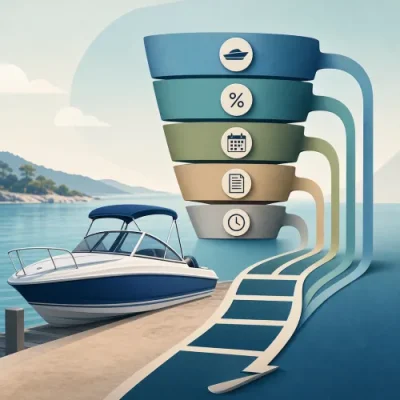
When lenders or calculators estimate boat finance repayments, several key inputs usually matter. The table below summarises the main factors and how they can influence the regular repayment.
| Factor | How it can affect repayments |
|---|
| Loan amount | A higher amount borrowed generally increases repayments, all else being equal. |
| Deposit or trade-in | A larger deposit or trade-in may reduce the amount financed, which may reduce regular repayments. |
| Interest rate | A higher rate increases the interest cost and usually increases repayments. |
| Loan term | A longer term may reduce each repayment but can increase total interest paid over the life of the loan. |
| Fees and charges | Upfront or ongoing fees can increase the total cost, especially if added to the loan balance. |
| Repayment frequency | Weekly, fortnightly or monthly repayment schedules can change cash flow and the timing of interest reduction. |
| Balloon payment | A balloon may reduce regular repayments during the term but leaves a larger amount due at the end. |
| Fixed or variable rate | Fixed rates may provide repayment certainty for a period, while variable repayments can change if rates move. |
Loan amount: the starting point for boat loan repayments
The amount borrowed is one of the clearest drivers of boat loan repayments. It may include more than the advertised purchase price of the boat, depending on the lender and the arrangement.
For example, the financed amount may be affected by:
- the agreed boat purchase price;
- any deposit you contribute;
- the value of a trade-in, if accepted;
- registration, equipment or trailer costs, if financed;
- insurance or protection products, if permitted and added to the loan;
- loan establishment or documentation fees, if capitalised into the loan.
Borrowing less usually reduces repayments, but it is also important to keep enough cash available for ownership costs such as insurance, storage, fuel, servicing, safety equipment and maintenance.
Interest rate and comparison rate
The interest rate is the percentage used to calculate the interest charged on the loan balance. In general, a lower interest rate reduces the interest component of each repayment, while a higher rate increases it.
Boat loan interest rates can vary according to lender criteria and individual circumstances. Factors may include credit history, income stability, existing debts, loan amount, loan term, whether the loan is secured, the age and type of boat, and the lender's risk assessment.
When comparing loans, it can also be useful to look at the comparison rate where one is provided. A comparison rate is intended to help show the cost of a loan by combining the interest rate with certain fees and charges. However, it may not include every possible cost or match your exact loan amount and term, so it should be read together with the full loan details.
Loan term: lower repayments can mean more interest over time
The loan term is the period over which the loan is scheduled to be repaid. A longer term generally spreads the loan balance over more repayments, which may reduce each individual repayment. However, because the loan runs for longer, the total interest paid may be higher.
A shorter term may increase regular repayments but can reduce the total interest paid if the rate and fees are otherwise similar. The right balance depends on affordability, cash flow, lender requirements and your broader financial position.
Repayment frequency and timing
Boat loans may offer monthly, fortnightly or weekly repayment options, depending on the lender and product. Repayment frequency affects budgeting because it determines how often money leaves your account.
Some borrowers prefer to align repayments with their pay cycle. Others focus on monthly budgeting. The important point is to compare repayment schedules carefully, because a weekly amount multiplied by four is not always the same as a monthly repayment over a full year.
If you use a calculator, check whether it assumes monthly, fortnightly or weekly repayments and whether it treats a year as 12 monthly payments, 26 fortnightly payments or 52 weekly payments.
How boat loan repayments are calculated in a calculator
A boat loan calculator typically estimates repayments by taking your loan amount, interest rate, loan term and repayment frequency, then applying a standard repayment formula. For a principal and interest loan, the estimate usually assumes each repayment covers interest for the period and pays down part of the loan balance.
A calculator can be useful for testing different scenarios, such as:
- how repayments change if you borrow less;
- how a different loan term affects the regular repayment;
- how rate changes affect affordability;
- how a deposit may reduce the amount financed;
- whether a weekly, fortnightly or monthly schedule better suits your cash flow.
Calculator results are estimates only. They may not include all fees, lender-specific criteria, insurance, government charges, marina costs, servicing or other ownership expenses. A formal quote or loan offer may differ after a lender assesses your application and the boat being financed.
Fees and charges can change the true cost
Fees can affect repayments in two main ways. If a fee is added to the loan balance, it increases the amount financed and may increase repayments. If a fee is paid separately, it may not change the repayment but still affects your upfront or ongoing cost.
Common fee categories to look for may include application, establishment, monthly account, documentation, early payout, late payment or variation fees. The names and amounts vary by provider, and not every lender charges the same fees.
When comparing boat finance repayments, it is worth asking whether the repayment estimate includes fees or only principal and interest.
Balloon payments and residual values
Some boat finance arrangements may include a balloon payment or residual value. This means a portion of the amount owing is left to be paid at the end of the loan term rather than being fully repaid through regular instalments.
A balloon payment may reduce the regular repayment during the loan term, but it does not remove the debt. At the end of the term, you may need to pay the balloon amount, refinance it, sell the boat, or make another arrangement accepted by the lender. Each option has risks and costs.
Before choosing a balloon structure, consider whether you are comfortable with the final payment and whether the boat's future value may be lower than expected. Market conditions, age, maintenance, engine hours and demand can all affect resale value.
Fixed versus variable repayments
With a fixed rate boat loan, the interest rate and repayment are generally set for an agreed period. This may make budgeting easier because repayments are more predictable during the fixed period, subject to the loan terms.
With a variable rate loan, the interest rate may move up or down. If the rate changes, repayments may also change. Variable loans may offer different features, but they also require borrowers to plan for possible repayment increases.
The suitability of fixed or variable interest depends on your circumstances, preferences and the products available. It is important to read the loan contract and understand any restrictions, break costs, fees or repayment rules.
Secured versus unsecured boat finance
Many boat loans are secured by the boat or another acceptable asset. A secured loan may have different pricing, borrowing limits and approval criteria than an unsecured loan because the lender has security if the borrower defaults.
An unsecured loan does not use the boat as security, but it may have different interest rates, loan limits or eligibility requirements. The repayment calculation still depends on amount, rate, term and fees, but the underlying risk assessment can differ.
If you are comparing boat loan finance options, check whether the loan is secured or unsecured and what that means for repayments, ownership obligations and default consequences.
Why two repayment estimates can be different
It is common to see different repayment estimates for the same boat price. This can happen because the estimate uses different assumptions, such as:
- a different loan amount after deposit or fees;
- a different interest rate or comparison rate;
- a longer or shorter term;
- weekly instead of monthly repayments;
- fees included in one quote but not another;
- a balloon payment included in one structure;
- secured finance in one estimate and unsecured finance in another;
- different assumptions about the boat's age, condition or use.
For this reason, it is useful to compare loans on both the regular repayment and the total cost over the full term. A lower regular repayment is not automatically the lower-cost option.
What lenders may assess before confirming repayments
An online estimate is not the same as a final loan offer. Before confirming repayments, a lender may assess information about you, the boat and the proposed loan structure.
This assessment may include:
- your income, employment and financial commitments;
- your credit history and repayment conduct;
- the amount you want to borrow;
- the loan term requested;
- whether the boat is new or used;
- the boat's age, condition, value and registration details;
- whether the purchase is private, dealer-based or business-related;
- the lender's security, insurance and documentation requirements.
Different providers may apply different criteria. A broker may also help explain why loan structures and repayment options vary between lenders. You can learn more about available assistance through the site's broker network.
How to estimate affordability before applying
Before applying for a boat loan, it can help to work through repayment affordability in stages:
- Set a purchase budget: include the boat, trailer, safety equipment, registration and any immediate repairs or upgrades.
- Estimate the amount to finance: subtract your deposit or trade-in and add any costs you expect to finance.
- Test repayment scenarios: use different loan terms, rates and repayment frequencies to see how repayments change.
- Allow for ownership costs: include insurance, servicing, storage, fuel and maintenance outside the loan repayment.
- Check your cash flow: consider whether repayments remain manageable if income or expenses change.
- Compare total cost: look beyond the regular repayment and consider interest, fees and any balloon payment.
- Read the loan terms: understand fees, early repayment rules, default consequences and any security requirements.
Key questions to ask about a repayment estimate
When reviewing a boat loan repayment estimate, consider asking:
- Is the repayment based on principal and interest?
- What loan amount has been used in the estimate?
- Are establishment or account fees included?
- Is the interest rate fixed or variable?
- What repayment frequency is assumed?
- Is there a balloon or residual payment at the end?
- What is the total amount repayable over the loan term?
- Are there early repayment or early payout fees?
- What happens if repayments are missed?
- What assumptions could change after a formal application is assessed?
Final thoughts
Boat loan repayments are calculated by bringing together the loan amount, interest rate, term, fees, repayment frequency and any special structure such as a balloon payment. Small changes to these inputs can make a noticeable difference to both regular repayments and total loan cost.
Before applying, use repayment estimates as a planning tool rather than a promise of final pricing or approval. Compare the assumptions behind each estimate, allow for the broader cost of boat ownership, and consider whether the repayment remains affordable under different scenarios.
Published: Friday, 7th Aug 2026
Author: Paige Estritori



No comments yet. Be the first to share your thoughts.